Descriptors of Acoustical Energy
Part of: Sound and Intonation → Drone-Based Practice
Sound can be described using four physical parameters: waveform, frequency, amplitude, and time. Each corresponds to a distinct perceptual experience — timbre, pitch, loudness, and sound envelope. The exercises on this page apply each parameter directly to brass performance, using drone-based practice as the training mechanism. Although the demonstrations are performed on French horn, every concept and exercise applies across the brass family.
A student new to the drone doesn't always know where to begin. Two things tend to go wrong without some coaching. First, transposing instrument players sometimes confuse the concert drone pitch with their written pitch — a horn player reading a second-line G is sounding concert C. If you're using a digital tuner like Tonal Energy, lock it into your instrument's transposition before any exercise. Second, the drone has to be loud enough to encourage you to play out. A weak drone cannot develop good intonation.
Before anything else, the best single piece of advice I can offer is something the former principal horn of the Cleveland Orchestra, Richard King, told me: always sound beautiful. Before pitch, before intonation, before any of the four descriptors — sound is the first responsibility.
Download and set up the Tonal Energy app before beginning. All exercises use it as a drone, a tuner, and a waveform analyzer.
The Framework
| Physical Descriptor | Perceived As | Associated Exercise |
|---|---|---|
| Waveform | Timbre | Perfect Unison Droning |
| Frequency | Pitch | Perfect 4th/5th Droning |
| Amplitude | Loudness | Loud Long Tone Droning |
| Time | Sound Envelope | Tapered Droning |
Video 1: Introduction — Intonation and the Drone
This video introduces the conceptual framework for the page and demonstrates the Tonal Energy app setup common to all four exercises.
The exercises are designed for just intonation rather than equal temperament. Equal temperament is an acoustical compromise — every interval except the octave is slightly mistuned from its naturally resonant counterpart. The difference is audible: equal temperament produces a subtle shimmer between two sustained pitches that disappears when those same pitches are tuned to just. That disappearance is the physical difference between two waveforms in conflict and two waveforms in agreement.
Show transcript ▼
Hello, my name is Jason. Welcome to Serve the Horn — thank you for joining me. The purpose of today's video is to talk about the basic concepts of intonation and droning. I'm going to introduce you to various tools you can use to better yourself as a musician, especially on the French horn. There will be a time later in the video where I'll ask you to play along.
Some of the most common intonation issues we run into as horn players actually have a lot to do with the body — not the ear. Here are three mechanics worth addressing before anything else.
Right hand. Your band director won't always notice, because the instrument hides your hand — but how you place it matters. Take your right hand with fingers together and a natural curve. Not cupped — a natural curve. Bring your thumb down parallel to the fingers, perpendicular to the ground. Put your hand in the bell with your knuckles against the far wall. This supports the instrument and places your hand far enough in to allow correct intonation.
Breathing. Most students take too small a breath, which causes them to play flat and pinched. Here is a simple method: say the words how to. Now say how backwards. It is a natural, uninterrupted cycle of air — no stopping. Take that breath every time you play.
Embouchure. Keep your chin flat and your corners firm, with a slight downward angle. Say the letter M — that firm but pliable lip position is your starting point.
On the Tonal Energy app: there are two types of temperaments we're going to use — equal and just. Most of these exercises are designed for just temperament, but let's first hear the difference.
[Demonstration: drone set to horn transposition, equal temperament. A C and a G — a perfect fifth. Now add the third, an E. Now switch to just temperament and listen.]
To set up Tonal Energy for this introduction: set the temperament to just, the key to C, the transposition to F+5, and hit the sustain button. Click on C3. Play against that drone. Notice what sharp looks like on the display. Notice what flat looks like. The app represents your pitch tendencies in real time, clearly and without mercy.
Enter the practice room. Focus on the tools and mechanics we've covered. You will have a greater chance of success in recognizing — and correcting — your intonation tendencies.
Descriptor 1: Waveform → Timbre
Every pitch you produce contains more than one sound. Within any given pitch are overtones located above the fundamental — each partial at a different frequency and amplitude — combining into what is called the resultant wave. It is the shape of this resultant wave, unique to each instrument, that the ear reads as tone color, or timbre (Johnston, 2019, p. 41).
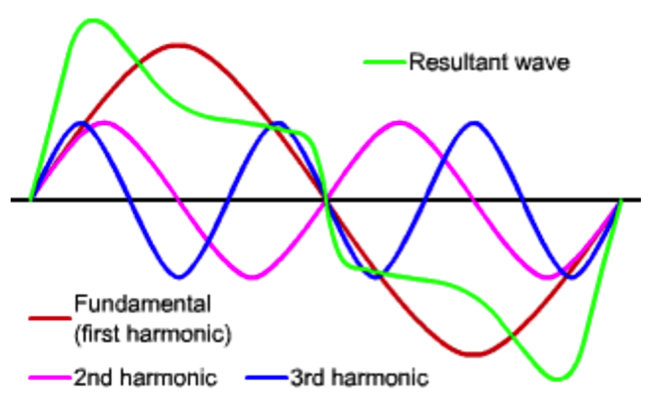 The fundamental (red) and its first two harmonics (purple, blue) combine to produce the resultant wave (green). The shape of this resultant wave is unique to each instrument — it is the physical blueprint for what the ear perceives as timbre. Image source: Commodore C128 System Guide, Chapter II, Section 7.3.1, Figure 7-233; cited in Johnston (2019), Figure 4-1-1.
The horn produces an attractive sound quality precisely because of the character of its resultant wave. A consistent, repeating wave shape is what the ear reads as focused, centered tone. An unstable or irregular waveform is heard as poor tone, regardless of whether the pitch is accurate.
When two instruments play the same pitch, their resultant waves interact. A perfect match produces no interference — the waves reinforce each other and the interval sounds acoustically resonant. A near-match produces audible interference: the rhythmic pulsing called beats. The rate of beating is proportional to the frequency difference between the two pitches (Backus, 1977, p. 70). Reducing that beating to zero is the goal of unison practice — and it requires listening not merely to pitch, but to waveform.
Research on timbral identification has shown that the attack portion of a tone carries a disproportionate share of the information the ear uses to recognize instruments. When attack portions are removed from recordings, identification collapses: a horn and an oboe and a cello become indistinguishable without their onsets (Elliott, 1975; Saldanha & Corso, 1964; cited in Johnston, 2019, p. 37).
The associated exercise, Perfect Unison Droning, trains the ear to hear and reduce waveform interference in real time. Focus on your timbre internally — as something you create and control, not something you react to. The drone is a mirror, not a target (Johnston, 2019, p. 27).
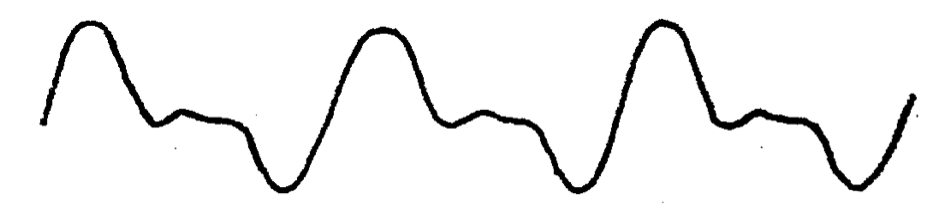 A consistent horn waveform as captured by an oscilloscope. The shape of this wave is the physical reality behind what we call "tone quality." Image source: attribution pending; use only if confirmed as an author-created capture, or replace before publication.
Exercise setup ▼
Set your drone to concert pitch, matched to your instrument's transposition. Start on a comfortable mid-range pitch. Play slowly — 60 bpm or slower. Rest after each note. Lower the drone one half step and repeat chromatically downward. Listen for beats and work to reduce them to zero.
Show transcript ▼
The auto-generated transcript for this video was unrecoverable. The video examines how physical vibrations in the air translate into the specific tonal colors that allow us to distinguish between different instruments — and how the shape of a waveform is the physical blueprint for what the ear perceives as timbre.
[Full transcript to be added when a clean version of the auto-captions becomes available.]
Descriptor 2: Frequency → Pitch
Frequency is the measurement of the number of periodic waves that pass a given point per second, measured in Hertz (Hz). More cycles per second produces a higher pitch; fewer produces a lower pitch. The relationship is measurable, consistent, and independent of any listener.
Pitch, however, is not the same thing as frequency. Pitch is the ear's internal, subjective response to frequency — and it is influenced by variables beyond the sound itself: technique, temperature, and the physical state of the player (Johnston, 2019, p. 28). A tuner reads frequency. The ear responds to pitch. When they disagree, both can be right.
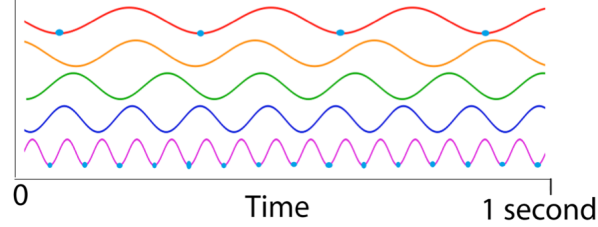 Multiple sine waves at different frequencies. The number of cycles per second determines the note — higher frequency, higher pitch. Image source: Nissa Garcia, "Wave Period: Definition & Formula," Study.com; permission noted in Johnston (2019), Figure 4-1-3.
This exercise is adapted from a method developed by Carmine Caruso and championed by Julie Landsman, former principal horn of the Metropolitan Opera. The perfect fourth and fifth are the two most naturally resonant intervals in the harmonic series, and using them as drone targets trains the ear to hear the difference between equal temperament's compromised tuning and the acoustically pure version of each interval.
The associated exercise, Perfect 4th/5th Droning, moves through the chromatic scale one half step at a time. The wide, open quality of the perfect fifth makes intonation tendencies immediately audible — and immediately correctable. → Drone-Based Practice
Exercise setup ▼
- Set the temperament to just.
- Set the transposition to C (zero) — do this before anything else.
- Confirm the drone note is set to C.
- Set the metronome to 60 bpm.
- Click the sustain button.
Move through the chromatic scale at your own pace. Double-click the next half step on the keyboard when you're ready. Take your time between pitches. Listen. Adjust. Keep the airstream moving steadily — consistent air produces consistent frequency.
Show transcript ▼
Hello, my name is Jason. Welcome to Serve the Horn. This video continues our discussion on the descriptors of acoustical energy. Today's topic is frequency and pitch.
From the previous video, you'll remember the sine wave. A sine wave can be represented as a frequency by counting the peaks and valleys that occur over a given period of time. More peaks and valleys per second means a higher pitch. Fewer means a lower pitch. That's what determines which note you're playing.
The exercise for this video is called Simple Perfect 5th Droning. Most beginning horn students have a tendency to play flat, simply due to a lack of proper airflow. Intermediate and above players have a real tendency to play sharp. This exercise is designed to address sharp playing.
Setting up Tonal Energy:
- Change the temperament to just.
- Change the transposition to C (zero). Do this first — it's important.
- Make sure the drone note is set to C. If it isn't, go to the keyboard and double-click C.
- Set the metronome to 60 beats per minute.
- Click the sustain button.
Here's how the exercise works: the drone holds a C. You play your horn C — which sounds a concert F, a perfect fifth below. A perfect fifth is a wide interval, and that means you need to play lower. Not dramatically lower, but noticeably so. Stay aware of this throughout the entire exercise.
Move through the chromatic scale at your own pace. When you're ready to move to the next pitch, double-click up one half step on the keyboard. In just temperament, C# will display as D-flat — the enharmonic equivalent. Continue upward chromatically.
A note on transposition: when you click C and play your horn C, the app confirms you're producing a concert F — a perfect fifth below. As you move through the exercise, each written note on your part will sound a perfect fifth below the drone. That relationship is exactly what we're training.
Take your time between each pitch. Listen. Adjust. Keep the airstream moving steadily. Consistent air produces consistent frequency.
Descriptor 3: Amplitude → Loudness
Amplitude is the measure of how much energy a sound wave carries, expressed in decibels (dB). We experience it as loudness. Two pitches can share the same waveform and frequency — but if one has greater peaks and valleys, it will resonate at a higher volume.
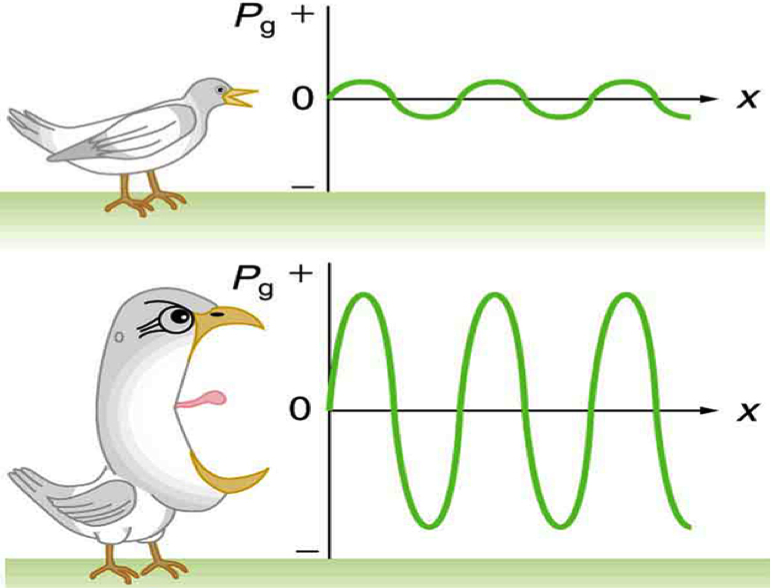 Two sounds at the same frequency, different amplitude. Same pitch — very different presence. Image source: Phil Schatz/OpenStax College Physics, "Sound Intensity and Sound Level," CC BY 4.0; cited in Johnston (2019), Figure 4-1-5.
Most students are unaware of how dramatically their sound changes between soft and loud dynamics. When playing loudly without adequate airstream management, the aperture becomes overwhelmed and the pitch climbs sharp. The player is throwing a lot of air through in a way that's out of control. The fix is not less air — it is better-directed air. Jaw slightly lower, corners firmer, oral cavity slightly more open. The note should feel larger, not harder (Johnston, 2019).
This exercise is adapted from a long tone study by Douglas Hill, one of the major figures in American brass pedagogy. The major sixth drone interval used in the exercise leans sharp by approximately 16 cents in just intonation — which means maintaining correct pitch while playing loudly requires managing both the interval and the dynamic simultaneously. That is a deliberately demanding combination.
The associated exercise, Loud Long Tone Droning, moves from pianissimo to triple forte against a fixed drone. → Drone-Based Practice
⚠️ Hearing health. Set the drone at a moderate level. Do not practice this exercise for extended periods at loud volumes.
Exercise setup ▼
- Set the temperament to just.
- Set the transposition to F (F+5 for horn; adjust for your instrument).
- Set the metronome to 60 bpm.
- Set the drone to a major sixth below your starting pitch. For a starting pitch of C, the drone note is E-flat. Double-click E-flat on the keyboard.
- Click the sustain button, then the tuner button.
The exercise moves from pianissimo to triple forte. If some notes are out of your comfortable range, skip them.
Show transcript ▼
Hello, my name is Jason. Welcome to Serve the Horn. This video continues our discussion on the descriptors of acoustical energy. Today's topic is amplitude and loudness.
Most young students have a difficult time playing in tune when playing loudly. This is because of a natural tendency to play very sharp without realizing it. The problem occurs because the student is throwing a lot of air through the aperture in a way that's out of control. In order to combat this, we have to practice bringing the pitch down when we play loudly.
I've borrowed an exercise from Doug Hill and adapted it for use with a drone. Doug Hill is one of our country's great horn pedagogues.
Before setting up the exercise, let me show you what sharp playing looks like in the Tonal Energy app. Click the tuner button — this gives a clean representation of the color wheel.
When you press down hard on the airstream and muscle the note out — pinching, biting — the circle wheel goes very high. That's sharp. What you actually need is airspeed, not pressure. Let the air go faster. Your aperture can easily get overloaded, so you have to be careful how you manipulate the air. Generally: jaw slightly lower, corners firmer, oral cavity slightly larger. Stop pinching. Stop biting so hard. Rely on a fast airstream.
Amplitude is the measurement of how much energy is contained within a sound wave, usually expressed using the decibel scale. We perceive that as loudness. Notice in the image: two waves with the same peaks and valleys occurring at the same time, but very different heights and depths. Same frequency. Very different amplitude.
Setting up Tonal Energy:
- Set the temperament to just.
- Set the transposition to F.
- Set the metronome to 60 beats per minute.
- Set the drone to E-flat — a major sixth below the C you'll be playing. Double-click E-flat on the keyboard.
- Click the sustain button, then the tuner button.
The major sixth is one of the more demanding intervals for brass players. It naturally leans sharp, which means playing it loudly while keeping the pitch down requires active management of both the interval and the dynamic simultaneously.
The exercise moves from pianissimo to triple forte. I've made a small adjustment to Doug's original: I've added quarter notes to keep the air moving forward. Breathe a lot. Keep the air moving. When you finish, there are many more variations below — set the drone to a major sixth below each starting pitch as you move through them. If some notes are out of your comfortable range, skip them. You're growing.
Descriptor 4: Time → Sound Envelope
Time, as a descriptor of acoustical energy, is the dimension in which every note unfolds. The sound envelope is the shape of a single tone across its complete duration. The ADSR model identifies four phases of that shape (Johnston, 2019, p. 37):
- Attack — the onset; how the note begins
- Decay — the transition period in which timbre develops and the center of the note is defined
- Sustain — the body of the note, maintained at stable amplitude
- Release — the controlled end of the tone
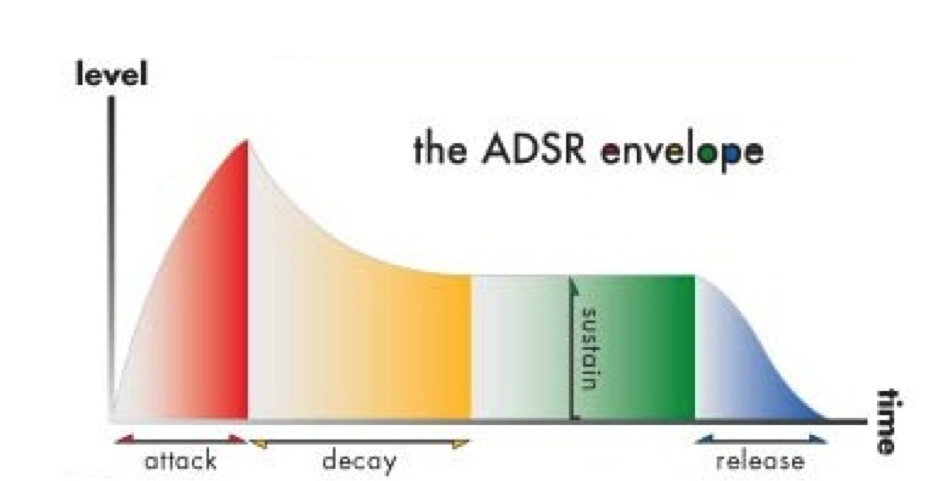 The ADSR envelope. Every note on every instrument has this shape, in proportions determined by the instrument, the player, and the musical context. Image source: SynthGear.com, "Why ADSR?" (2010); permission noted in Johnston (2019), Figure 4-1-7.
Each phase has its own intonation tendencies. The attack must be fast enough for the sound to properly develop. In the decay, young players tend to let the pitch sag flat as the tone settles. The sustain wobbles when the player over-corrects. The release — most often neglected — either drops flat when the air stops too soon, or shoots sharp when a tongue stop is applied. A drone makes all of these problems audible. The Tonal Energy app's Analysis feature makes them visible (Johnston, 2019, p. 38).
This exercise was inspired by the Pre Warm-Up in Philip Farkas's The Art of French Horn Playing — one of the foundational texts of American brass pedagogy.
The associated exercise, Tapered Droning, applies the ADSR model directly to practiced performance. → Drone-Based Practice
Exercise setup ▼
- Set the temperament to just.
- Set the key to F and the transposition to F+5 (adjust for your instrument).
- Click the sustain button.
- Click the Analysis button. Start with Wave mode. Once comfortable, switch to Both — this adds an orange pitch line so you can monitor pitch and envelope simultaneously.
The exercise is arpeggiated within the key of F — F major and F minor. Four versions are provided: half note, dotted quarter, quarter note, and staccato eighth note. Start with Version 2 (dotted quarter). Sing every pitch before you play it. Play slowly. Interact with the drone. There will be notes that are not where they are supposed to be — that is the exercise.
Show transcript ▼
Hello, my name is Jason. Welcome to Serve the Horn. This video finishes our discussion on the descriptors of acoustical energy. Today's topic is time and the sound envelope.
The sound envelope is a graphic representation of what a sound looks like over its duration. There are four parts:
- Attack — the front of the note; the onset.
- Decay — where the timbre develops and the center of the note is defined.
- Sustain — the length and core of the note, fully developed.
- Release — the ending of the note.
We're going to use the Tonal Energy app's Analysis feature to see what your sound envelope looks like when you play.
Setting up Tonal Energy:
- Set the temperament to just.
- Set the key to F — double-click F on the keyboard or wheel.
- Set the transposition to F+5.
- Click the sustain button.
- Click the Analysis button. You'll see three options: Wave, Tuning, or Both. Start with Wave.
[Demonstration: two versions of a note — one with an abrupt cutoff, and one with a tapered release. The abrupt cutoff leaves a flat, hard back edge in the analysis display. We want the taper.]
A lot of students cut their notes off too quickly. The Analysis display shows this clearly — the back of the envelope looks like a wall. What we want is a taper. The release should be gradual and controlled, carried all the way to silence by the air.
Tapered Droning was inspired by Philip Farkas's Pre Warm-Up from The Art of French Horn Playing. The exercise is arpeggiated and built within the key of F — F major and F minor — which leaves out the flat second (G-flat) and the tritone (B-natural). There are four versions: half note, dotted quarter, quarter note, and staccato eighth note. We'll use the dotted quarter version — Version 2 on your sheet music.
Once your drone is set and Analysis is running, switch to Both mode. This displays the sound envelope along with an orange pitch line. The goal: keep the orange line as close to center as possible while maintaining a clean envelope shape. There is a lot to look at — that is the point.
Note: when you reach the fifth or sixth line of the exercise, the triad shifts to G — B-flat — D-flat. That triad is not F major, but all of those notes are within the key of F. Keep tuning everything to F throughout.
Set the metronome to 60 beats per minute when you're comfortable. My suggestion: play this very slowly and let the drone do its work. There will be notes that aren't where they're supposed to be. I'm going to be doing some practicing too.
Sources
- Backus, John. The Acoustical Foundations of Music, 2nd ed. New York: W.W. Norton, 1977.
- Elliott, C. A. "Attacks and Releases as Factors in Instrument Identification." Journal of Research in Music Education 23 (1975): 35–40.
- Farkas, Philip. The Art of French Horn Playing. Evanston, IL: Summy-Birchard, 1956.
- Johnston, Jason M. The Effects of Drone-Based Instruction on Beginning Band Students' Individual Performance Achievement. DMA dissertation, University of North Carolina at Greensboro, 2019.
- Saldanha, E. L., and John F. Corso. "Timbre Cues and the Identification of Musical Instruments." Journal of the Acoustical Society of America 36 (1964): 2021–2026.
Image Sources
- Commodore Electronics Limited. Commodore C128 System Guide, Chapter II, Section 7.3.1, Figure 7-233. Cited in Johnston (2019), Figure 4-1-1.
- Garcia, Nissa. "Wave Period: Definition & Formula." Study.com. Permission noted in Johnston (2019), Figure 4-1-3.
- Schatz, Phil/OpenStax College Physics. "Sound Intensity and Sound Level." Licensed CC BY 4.0. Cited in Johnston (2019), Figure 4-1-5.
- SynthGear.com. "Why ADSR?" 2010. Permission noted in Johnston (2019), Figure 4-1-7.
- Oscilloscope horn waveform: attribution pending; confirm author-created capture or replace before publication.